
METiS TechBio (7666.HK), a global leader in AI-powered drug delivery innovation, today announced that new preclinical data from its heart-targeted LNP program has been selected for a Late-Breaking oral presentation at the 2026 Controlled Release Society (CRS) Annual Meeting. Dr. Andong Liu, Vice President and Head of Technology Platform at METiS TechBio, will deliver a Late-Breaking oral presentation at the 2026 CRS Annual Meeting in Lisbon, Portugal, this July. The presentation is titled “Systemic Heart-Selective Lipid Nanoparticles for High-Efficiency In Vivo Delivery and Cardiomyocyte Gene Editing.”
In this study, leveraging its proprietary NanoForge AI nanodelivery platform, METiS TechBio achieved near-complete (~100%) cardiomyocyte transfection and significant gene editing following intravenous administration through AI-driven lipid discovery, formulation optimization, and active targeting ligand engineering. The selection of these findings for a Late-Breaking oral presentation at this year’s CRS Annual Meeting represents a significant advance in extrahepatic LNP delivery, establishing a first-in-class precision delivery capability to cardiomyocytes.
The heart has long been considered one of the most challenging organs for extrahepatic LNP delivery. Cardiomyocytes, due to their high density and low endocytic activity, are widely recognized in the industry as one of the most difficult cell types for efficient delivery. Achieving near-complete cardiomyocyte transfection means that, for the first time, genetic medicines may be able to reach cardiomyocytes via systemic administration with substantially improved precision and efficiency while reducing off-target risks. This opens up new therapeutic possibilities for major cardiovascular diseases and clinical needs, including hereditary cardiomyopathies, heart failure, and post-myocardial infarction repair. It also signals that AI-driven organ-targeted delivery technology is advancing from proof-of-concept toward potential clinical value.
“Extrahepatic delivery remains one of the most important challenges in genetic medicine,” said Dr. Chris Lai, Chairman and CEO of METiS TechBio. “These findings demonstrate the potential of our AI-driven NanoForge platform to enable precise delivery to cardiomyocytes, which could open new possibilities for in vivo gene editing therapies targeting cardiovascular diseases.”
Lipid nanoparticles (LNPs) are a versatile and clinically validated non-viral platform for delivering large genetic payloads. However, achieving organ-specific delivery beyond the liver remains a major unresolved challenge in the field of genetic medicine. In this study, METiS TechBio utilized the high-throughput in vivo screening system and AI lipid design engine under the NanoForge platform to identify LNPs with specific tissue tropism. The research team evaluated candidate LNPs in mTmG mouse models, using Cre-mRNA to induce eGFP expression as a readout for functional intracellular delivery. After identifying lead lipids with heart-specific tropism, the team further optimized the formulation to enhance cellular uptake, and subsequently functionalized the particles with antibody-targeting ligands to generate actively targeted LNPs (tLNPs). To evaluate their therapeutic potential, lead tLNPs were used to deliver the CRISPR-Cas9 system to quantify gene editing efficiency in the myocardium.
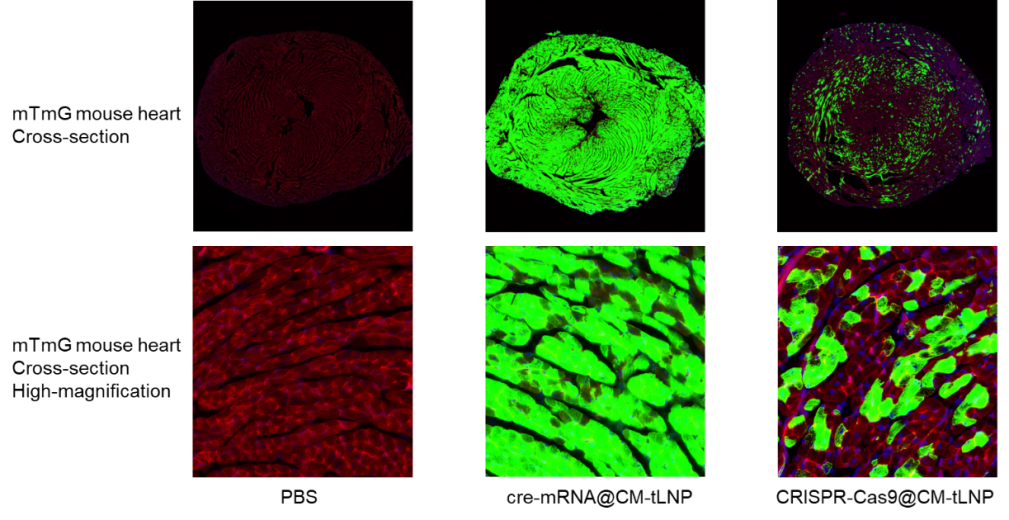
Transfection and Gene Editing Performance of Cardiomyocyte-Targeted tLNP (CM-tLNP) in Cardiomyocytes Following Intravenous Administration
The initial lead lipids exhibited a cardiomyocyte delivery efficiency of ~30%, which increased to ~70% following formulation optimization. Upon functionalization with targeting ligands, the cardiomyocyte-targeted tLNP (CM-tLNP) achieved near-complete (~100%) cardiomyocyte transfection. Furthermore, delivery of the CRISPR-Cas9 system resulted in significant genomic editing within the myocardium, confirming the strong therapeutic potential of the platform for cardiac applications.
NanoForge is the world’s first AI nanodelivery platform independently developed by METiS TechBio. It features the world’s largest ionizable lipid library at the scale of tens of millions, a proprietary lipid de novo generation algorithm and lipid language model, the world’s first end-to-end lipid and lipid nanoparticle (LNP) screening platform, and an original AI-powered multiscale simulation platform for small-molecule formulation development. Building upon NanoForge, the Company has developed three major technology solutions: AiTEM, AiLNP, and AiRNA. The AiLNP platform currently provides deep analytical insights through artificial intelligence and molecular dynamics simulations, predicts more than 20 lipid property parameters, and enables the design and optimization of key LNP components and their ratios to build customized, high-performance delivery systems.
Founded in 1978, the Controlled Release Society (CRS) is one of the world’s most authoritative non-profit academic organizations in the fields of drug delivery systems and nanomedicine. With members from more than 50 countries and regions, CRS spans interdisciplinary fields including pharmaceutics, materials science, biomedical engineering, nucleic acid therapeutics, and translational medicine. The CRS Annual Meeting attracts thousands of experts from leading international universities, research institutions, and multinational pharmaceutical companies each year, and is regarded as a leading forum and launchpad for global drug delivery and nanomedicine technologies.